
Let’s be honest—today’s clients are more educated than ever.
They walk into your salon asking about ingredients, sourcing, installation methods, and one critical topic: Hair Structure and Health.
They’re not just buying longer hair.
They’re buying protection. Longevity. Confidence.
And if you’re a salon owner, wholesaler, or brand merchant, the real question becomes:
Are your suppliers helping you protect hair structure and health—or quietly compromising it?
Because here’s the truth:
No matter how skilled your stylists are, poor-quality extensions will damage reputation faster than any bad haircut.
This guide breaks down exactly what you should demand from a supplier if you care about Hair Structure and Health—and how a professional hair extension manufacturer should support your business.
Why Hair Structure and Health Should Be a Top Priority for Salons
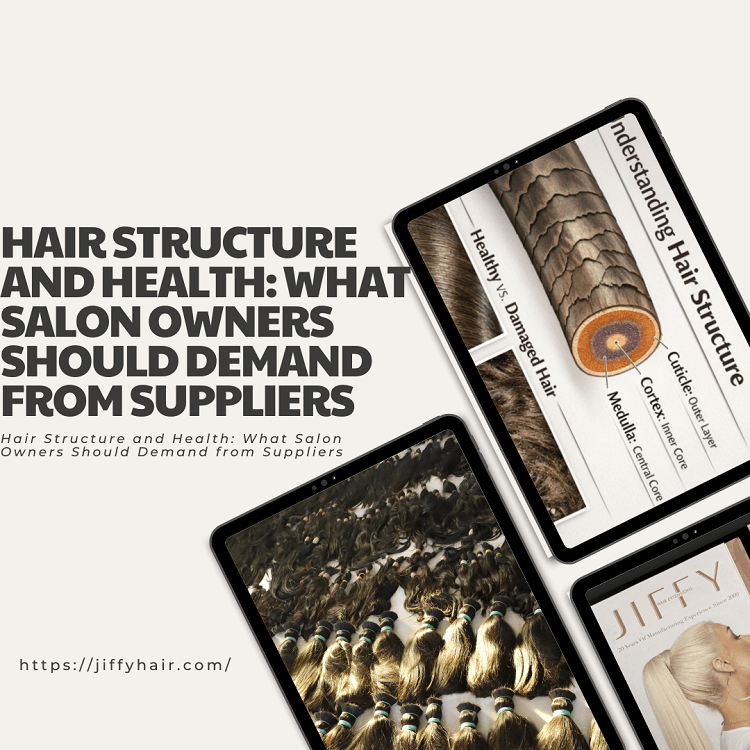
Hair isn’t just a cosmetic fiber. It’s a biological structure made up of:
Cuticle (outer protective layer)
Cortex (strength and elasticity core)
Medulla (central structure, often absent in fine hair)
When Hair Structure and Health are compromised, you’ll see:
Breakage
Frizz
Loss of elasticity
Thinning
Client dissatisfaction
Key Takeaway
Salon profitability depends on protecting hair structure and health before, during, and after extension installation.
If your supplier ignores this, your salon pays the price.
What Does “Healthy Hair Structure” Actually Mean?
Healthy Hair Structure and Health are defined by:
Intact cuticle alignment
Balanced moisture retention
Elasticity under tension
Minimal protein loss
Smooth surface integrity
In extension terms, this means the hair should:
Resist matting
Maintain softness after washing
Withstand heat styling
Blend naturally
High quality hair extensions for salons must support—not disrupt—natural hair structure.
Why Choose Jiffy Hair for Your Salon’s Hair Health Standards
When it comes to protecting Hair Structure and Health, not all suppliers are created equal. That’s where Jiffy Hair stands out.
As a professional hair extension manufacturer, Jiffy Hair provides 100% human hair extensions that are cuticle-aligned, tangle-resistant, and designed for maximum durability. Whether your salon specializes in tape-in extensions, wefts, nano rings, or clip-in hair extensions, Jiffy Hair has the right product to suit every client’s needs.
By choosing high-quality hair extensions for salons from Jiffy Hair, you ensure:
Superior hair structure protection – extensions that move naturally with your client’s hair
Low-tension, scalp-friendly designs – ideal for weak or fine hair
Consistent, premium quality – every batch goes through strict factory quality control
Professional support – from installation guidance to aftercare tips
Plus, with wholesale options, salons and brand merchants can stock up cost-effectively without compromising on quality. Make the switch to Jiffy Hair and provide your clients with beauty that doesn’t come at the cost of hair health.

Do Hair Extensions Damage Hair Structure? Let’s Address It Directly
This is one of the most common client concerns:
“Do hair extensions damage hair structure?”
The honest answer?
It depends.
Extensions can damage hair structure when:
Weight exceeds hair capacity
Tension is uneven
Bonds are oversized
Removal is careless
Hair quality is poor
But extensions do NOT damage hair structure when:
Installed correctly
Matched to hair density
Removed professionally
Made from high-quality materials
Key Takeaway
Hair extensions themselves are not the problem. Poor manufacturing and improper installation are.
A professional hair extension manufacturer designs products with structural integrity in mind.
How Can Salon Owners Evaluate a Supplier’s Commitment to Hair Structure and Health?
Here’s where you need to be strategic.
Ask your supplier:
Is the hair cuticle-aligned?
Is the weight evenly distributed?
Are adhesives dermatologically safe?
Is tension testing performed?
What quality control processes are in place?
If they can’t answer confidently, reconsider.
High quality hair extensions for salons must pass structural and durability testing.
What Makes a Professional Hair Extension Manufacturer Different?
Not all suppliers are equal.
A true professional hair extension manufacturer:
Controls raw hair sourcing
Maintains strict quality inspections
Tests weft durability
Ensures uniform density
Balances strand thickness
They understand Hair Structure and Health on a technical level—not just a marketing one.
Direct Industry Fact:
Factories that align cuticles properly significantly reduce tangling and structural stress.
How to Repair Damaged Hair Structure Before Installing Extensions
Sometimes clients already arrive with compromised hair.
So how to repair damaged hair structure before applying extensions?
Recommended steps:
Protein treatments to rebuild cortex strength
Moisture masks to restore elasticity
Trim split ends
Pause chemical services
Use lightweight extension methods
Key Takeaway
Installing extensions on severely weakened hair without repair increases breakage risk.
Education protects both client hair and your brand.
What Are the Best Hair Extensions for Weak Hair?
If a client has fine or fragile hair, not every method is suitable.
The best hair extensions for weak hair typically include:
Lightweight tape-ins
Nano rings with micro sections
Seamless flat wefts
Low-gram customized sets
These methods distribute weight more evenly.
Direct Statement:
The best hair extensions for weak hair are those that reduce root tension and minimize scalp pressure.
Why Weight Distribution Matters for Hair Structure and Health
Weight imbalance is one of the biggest threats to Hair Structure and Health.
When extensions are too heavy:
Roots stretch
Follicles weaken
Breakage increases
Tension alopecia risk rises
A responsible professional hair extension manufacturer designs extension sets in varied gram options.
Key Takeaway
Extension weight must match client density—not trend volume.
What Role Does Cuticle Alignment Play?
Cuticle alignment is everything.
When cuticles are aligned:
Hair moves naturally
Tangling reduces
Surface friction decreases
Brushing stress is minimized
When cuticles are stripped or reversed:
Hair mats
Clients over-brush
Structural damage increases
High quality hair extensions for salons must maintain cuticle integrity.

How Adhesives and Attachments Affect Hair Structure and Health
Salon owners often overlook adhesive safety.
Tape adhesives must be:
Medical-grade
Non-irritating
Residue-controlled
Easy to remove
Nano beads should:
Be silicone-lined
Match hair color
Avoid sharp edges
Key Takeaway
Attachment safety directly impacts Hair Structure and Health.
Why Installation Technique Is Only Half the Equation
You can have perfect technique—but if the extension hair itself is weak, problems follow.
Low-grade extensions:
Tangle quickly
Shed excessively
Lose moisture
Cause clients to over-manipulate hair
This extra manipulation weakens natural strands.
A professional hair extension manufacturer ensures consistent quality batches.
How Suppliers Should Support Salon Education
A responsible supplier doesn’t just sell bundles.
They provide:
Installation guides
Weight recommendations
Removal protocols
Aftercare instructions
Hair structure education
Hair Structure and Health should be part of supplier communication.
Why Salon Reputation Depends on Hair Health Outcomes
Clients don’t always blame the factory.
They blame the salon.
If they ask:
“Do hair extensions damage hair structure?”
And experience breakage—
Your reputation takes the hit.
Choosing high quality hair extensions for salons protects your long-term credibility.
How to Build a Hair Health-Focused Extension Menu
Smart salons now categorize services by:
Hair density
Hair condition
Weight tolerance
Structural resilience
This consultative approach increases trust.
Offering the best hair extensions for weak hair positions you as a specialist—not just a stylist.
What Salon Owners Should Demand in 2026
Here’s your checklist:
✔ Cuticle-aligned human hair
✔ Multiple weight options
✔ Low-tension systems
✔ Transparent sourcing
✔ Quality control reports
✔ Education support
✔ Scalp-safe attachments
Hair Structure and Health must be a supplier priority—not an afterthought.
Conclusion
Hair Structure and Health are no longer optional talking points—they are core business principles.
Salon owners who prioritize structural integrity see:
Fewer complaints
Higher client retention
Stronger brand authority
More repeat extension services
If clients are asking, “Do hair extensions damage hair structure?”—you need answers.
If you’re wondering how to repair damaged hair structure before installation—you need protocols.
And if you’re choosing the best hair extensions for weak hair—you need a professional hair extension manufacturer committed to quality.
High quality hair extensions for salons should enhance beauty without compromising biological integrity.
Because in the long run, healthy hair builds healthy businesses.
FAQs
1. Do hair extensions damage hair structure permanently?
No, not when installed correctly and matched to hair density. Damage usually results from poor application or low-quality products.
2. How to repair damaged hair structure before extensions?
Use protein treatments, moisture restoration, trims, and allow recovery time before installation.
3. What are the best hair extensions for weak hair?
Lightweight tape-ins, nano rings, and seamless wefts are often safest for fragile strands.
4. Why is cuticle alignment important for Hair Structure and Health?
Aligned cuticles reduce tangling and friction, minimizing stress on natural hair.
5. What defines a professional hair extension manufacturer?
A factory that controls sourcing, performs quality testing, maintains cuticle alignment, and designs products to protect hair integrity.

Jiffy Hair Factory is an experienced hair factory, we not only care about the quality of the wholesale hair extensions we provide, but also care about boosting your hair business.
If you want to get a reliable hair supplier, click “here” to send us an inquiry!

 English
  Español